pegkerr: (Default)
I have been thinking about defiance over the past week.

A half mile from my house, a homeowner has put four-foot high standing letters in their front yard that light up at night. The letters spell out "RESIST." I see them every day as I drive by.

A friend sent me a link about a non-profit, Unidos MN, that was holding Legal Witness Training at a church in Minneapolis. The organizers originally expected an attendance of about 150 people. So many people registered, however, that they ended up moving it from Holy Trinity to Central Lutheran.

Fifteen hundred people showed up.

I was one of them. The purpose of the training was to recruit volunteers to agree to receive text alerts when word came from the dispatchers that ICE was doing a raid to arrest immigrants. People go out to serve as legal witnesses, to hold police responsible and to share rights information with those being arrested, and to be there as moral witnesses, to let immigrants know that they are not standing alone.

The presentation seemed well thought out. The organizers stressed that the intention is not to provoke confrontations, but, they admitted, sometimes these things can go badly. Most raids occur between 4 am and 8 am. They advise letting someone know when you are about to go out to witness a raid, just in case. Make sure your phone is passcode locked, and not openable with biometrics (I privately thought it might be better to carry a burner phone).

It all sounds daunting. But the reality of what is going on in this country is daunting. Can I stand by and do nothing? What SHOULD I be doing?

The whole experience led to a lot of thinking about what we are facing, about fascism and the duty to resist. I kept thinking how familiar it all seemed and poked at that thought until I found the connection.

You see, I spent seven years writing daily with a dozen other writers in an online collaborative story about people living in a fascist regime and taking it down in the end. I'm talking about Alternity. I wrote stories about people who resisted covertly and others who resisted openly. I wrote about people who worked within a cruel bureaucracy, trying to save as many as possible. I wrote about people who bought into the regime because of the power it gave them, addicted to the thrill of being able to force others to do what they wanted. I wrote about people who left their lives behind to fight openly, and how some won, and some sacrificed everything.

Writing Alternity was the best preparation I could have imagined for living in these times. We wrote about the insidious nature of propaganda, and groupthink, and about being betrayed by family and friends and the despair of watching people you love willingly swallowing poison and turning against you. We wrote about the little accommodations to evil that are so easy to make and the terrible things that those little compromises can slowly lead you to do. We wrote about the erosion of morality and the building of courage. We wrote about what happens to people when everything is falling apart all around them.

I look around today and almost marvel: we're living it. We are in the beginning stages of Alternity. When we wrote the story, we assumed that of course it will never happen here. But now we see fascism on the rise, and what are we going to do about it?

What am I going to do about it?

I remember reading Corrie Ten Boom's autobiography when I was a kid. I thought about the movie I saw about Sophie Scholl and the White Rose. Absorbing those stories led to a kind of moral exercise, a thought experiment examining the question, "What would I do in that situation?" Of course, you think that you will be brave. You will stand up to the powers that be to protect the oppressed innocent; of course you will.

Yet, my finger hovered for an inordinately long time over the sign-up button below the question on the app: "Are you willing to volunteer to be a legal witness?" I felt sick. I felt afraid. It is still difficult to believe that this is actually happening. And yet I know, from writing Alternity, that fascism builds its momentum by convincing people that its power is overwhelming. You must stand up from the very beginning to say, "No."

I have come to deplore JK Rowling and all the hatred she represents. And yet I found myself thinking: "Am I a Gryffindor or not, dammit?"

In the end, I haven't yet committed to being a legal witness, but I will be attending the next training to learn more. I may yet sign up, or I may find another role, another way to assist. In the meantime, I've used my position at my job to pass much of this information along to church leaders to let them know about this initiative.

I learned this week that courage can seem easy when all you're doing is dreaming about what-ifs. It is a lot more difficult when you are facing the necessity of being brave in real life. And it is going to get much more challenging. We are just at the beginning.

Worse is yet to come. So the defiance has to start now.

About the design: one of the things I picked up in my reading this week was the historical tidbit about why red lipstick was so popular in World War II. Apparently, the word filtered out from Germany that Hitler hated women wearing makeup. When women were invited to join his entourage on his retreats, there was a strict dress code that they couldn't wear makeup, particularly red lipstick.

So American women started adopting red lipstick as a marker of resistance to fascism.

The starfish is included because of that old story about the man who walks along a beach, throwing starfish back into the water after a storm. When asked why he bothers, that his actions are useless because there are so many starfish littering the beach, the man picks up another starfish, throws it in, and says, "I made a difference to that one."

The ouroboros (the snake in a figure 8 devouring its tail) is included in the design because it was Voldemort's symbol of the regime in Alternity.

Central images: Men in black jackets with "Police ICE" on the back converge on a front door decorated with a Christmas wreath. Lower center, semi-transparent: an ouroboros (a snake curled in a figure-8, swallowing its own tail). Bottom center, over the ouroboros: an open white rose. Behind the ouroborus, lower left corner, a hand tosses a red starfish (center). Lower right corner: tips of a woman's fingers apply fire engine red lipstick to a pair of lips (directly over the starfish).

Defiance

6 Defiance

Click on the links to see the 2025, 2024, 2023, 2022 and 2021 52 Card Project galleries.
pegkerr: (All we have to decide is what to do with)
*Deep breath*

Okay.

This is maybe the most complicated-in-thought card I've ever done (the card is at the end of this rather long post). I will try to explain it, and doubtless, some will be TL;DR and/or I may miss the mark in explaining it (if so, sorry!), but, well, it is important to me. And it's been the result of/prompted by the sort of deep reflective inner work that I hoped this project would spark, so I'm pretty pleased with it. Both aesthetically and what it's opened deep within myself.

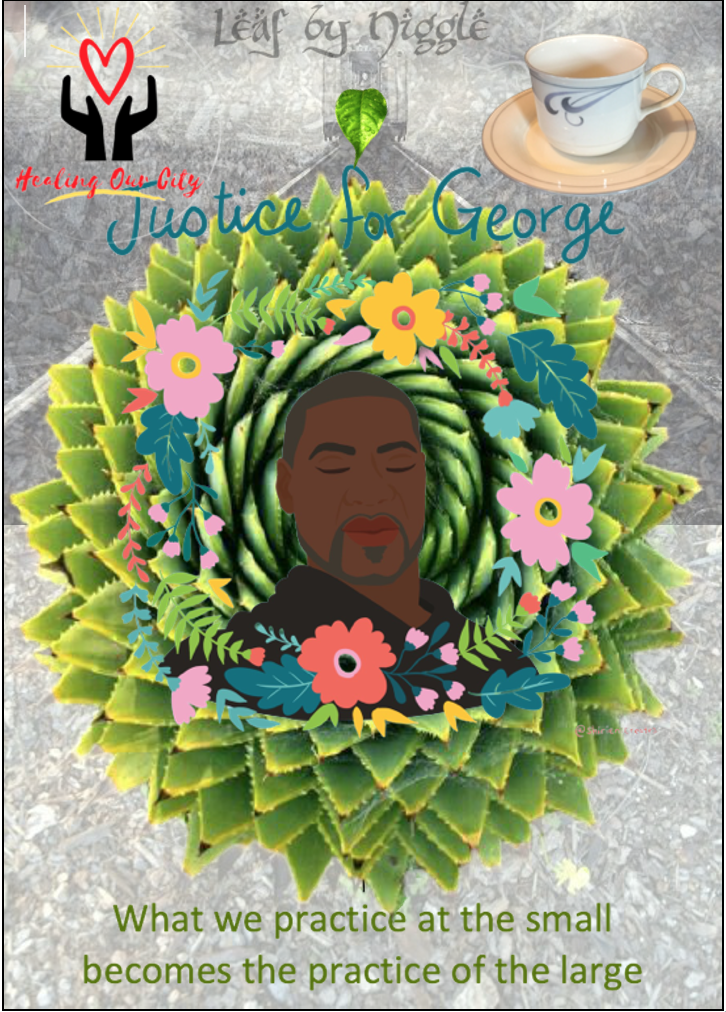
The card started with my tuning into one of the prayer gatherings being held at 8:00 a.m. every morning while the Chauvin trial is going on, hosted by the organization Healing Our City (some of the organizers have ties to the Minneapolis Area Synod for the ELCA, my employer, and several of my coworkers are tuning in every day).

The day's reflection leader, Rev. Frenchye Magee of Hennepin Avenue United Methodist, invited the listeners to reflect on an image, a plant growing in a fractal pattern, which is common in nature, as we considered the thought, "What we practice of the small becomes the practice of the large." Large changes, she explained, begin with the smallest changes we make in ourselves as we engage in the work of social changes and justice, and those changes spiral out, becoming an opportunity to repeat the pattern in ever-enlarging arcs of love and hope and healing that transform the world.

As I thought over the next few days about this meditation, I made the connection with what I am doing in my own life. Last week's card, Books, was about the small, laborious changes I am making in my own life to open up space for something new. This past week, I shipped off my wedding china to a company that deals with used china as part of this downsizing/changing process (see the teacup in the upper right).

"Wait a minute!" you cry in outrage. "Stop right there! How dare you turn a meditation about the changes necessary to bring about social justice into a rumination about downsizing and decluttering. How self-centered and self-absorbed can a white woman be!" Well, yes, but please give me a moment to explain. I promise I will tie it all together.

I have been studying the concept of hygge for the past couple of years, and as I have been dealing with All of Rob's Stuff, I have become aware of the Swedish term döstädning, or as it's called in English, Swedish Death Cleaning. As I have struggled to go through all of Rob's stuff, I have sworn to myself, time and time again, I WILL NOT DO THIS TO MY GIRLS. I am aware that I have to make the hard choices, the small changes--but it's not only about simplifying my life to be kind to others after my death. I need to be aware of the changes I need to make in my mentality--caring more about people than things--not just in preparation for my own death, which hopefully, will be a long ways off yet. But also it's necessary to open up space for the life I truly wish to live.

There is nothing like becoming a widow to make you think about preparing for death. I saw how Rob became less and less tethered to his possessions as he lay dying in the hospital. He didn't care to read or open his laptop, and he didn't show as much interest as expected in the gifts we brought him, certainly far less than usual.

What ties it all together was something prompted by a song included as a part of worship in another Healing Our City gathering later in the week: People Get Ready:

People get ready
There's a train a comin'
You don't need no baggage
You just get on board
All you need is faith
To hear the diesel's hummin'
You don't need no ticket
You just thank the lord

(See the ghostly train at the top of the card.) The song, as well as all the thinking I have been doing about making small changes in my life, made me remember J.R.R. Tolkien's great story "Leaf By Niggle." (You can listen to a lovely recording of the story being read here. Which is coincidentally where I got the script spelling out "Leaf by Niggle" in a font based on Tolkien's own lettering, that you see overlaying the ghostly train. Niggle's perfect leaf, dappled by dew, is underneath.)

Niggle was preoccupied by his own concerns, his hope of painting a perfect tree, leaf by glorious leaf. He is annoyed by the constant demands put upon him by his neighbors, especially the intrusive Parish. The constant interruptions cause him to neglect his work; in turn, his inability to finish his work caused him to be insufficiently concerned about his neighbors. Finally, he was called away from his work because he had to go on a long journey on a train, clearly a metaphor for death ("There's a train a comin' / You don't need no baggage / You just get on board"). It is not until he undergoes a series of small changes (in a realm that reflects Tolkien's Roman Catholic conception of Purgatory) that his heart opens up to his neighbor Parish, and in return, he discovers his Great Tree, a real living tree, as he pictured in his imagination but could not quite capture.

Luke 12: 13-21 tells the story of the rich fool, who cared only for building barns and piling up his wealth, until God required his soul to come to death, and what good did his riches do him then? A related parable is the story of the rich man and Lazarus in Luke 16:19-31: a rich man thinks only of his possessions and his own pleasures, ignoring the downtrodden Lazarus outside his gate until both come to death, and what good did his riches do him, in comparison to what he should have done for Lazarus? (“Business!” cried the Ghost, wringing its hands again [in Dickens' A Christmas Carol]: “Mankind was my business. The common welfare was my business; charity, mercy, forbearance, and benevolence, were all my business. The dealings of my trade were but a drop of water in the comprehensive ocean of my business!”)

What should we do for Lazarus? What should we do for Parish? What should we have done for George Floyd, who had his life cut short by death? What small changes do I need to make in my life to open myself up to them? I hasten to explain that I'm not trying to say that de-emphasizing possessions is the work here; it's part of it, but mostly I'm pointing that process out as a metaphor for the work. I hope I can escape self-absorption, and make the changes to turn my attention away from mere things to the people around me: my neighbors Lazarus, and Parish, and George Floyd. And I have to make the small changes to root unhappy patterns out my life, including, yes, the inner racism I am training myself to see, the small selfishnesses, like putting away and getting rid of the old familiar things in my life that are no longer appropriate to the life I wish to lead. And in doing so, I think I can open myself up more fully to truly seeing and helping my neighbor.

It is difficult. It will take many small changes. But death is one of the few certainties in life. It puts so much into perspective, and things become so much clearer.

(So...did I manage to tie it all together? And did you actually read through all the way to the end???)

Changes


Click here to read about the 52 card project and see the year's gallery.
pegkerr: (Excellent you seem to be coming to your)
I have been thinking quite a bit about this article the last couple of days. Marriage equality has come to Minnesota, but some people, apparently are all about the 'Oh Noes!' and 'The moral downfall of our state' and 'Hate the sin and love the sinner.'

I've been probing my own feelings about this. It's difficult: I want to both mock and get angry. Part of my emotion comes from the fact that when I was much, much younger, I suppose I would have been disapproving of marriage equality--if I had even thought about it, which no one I knew did back in the 80s. Why did my opinion change? It was because I came to actually know some gay people, and it all crystallized because of all the research I did for The Wild Swans. The other reason was that I hear echoes of my Dad in some of the words here. I called him on it, strenuously, when I scolded him for his vote in Georgia. I do wonder if I would have been able to change his mind if he had lived long enough to vote on the matter in Minnesota. I would like to think so. He was certainly ashamed of himself when I explained to him that he had, entirely without realizing it, voted against civil unions too when he cast his vote in Georgia, which he hadn't intended to do.

I remember the conversation I had with a co-worker a long time ago about gay civil rights. She was very conservative, and I tried to open her mind a little. She got quite offended, and as she stalked back to her desk, she said something revealing: 'I'm too old.' As in too old to change her mind? That comment has always haunted me.

This article, "Why Privilege is Hard to Give Up" was fortuitously timed to reflect upon the first article I linked above. It's true: these people have been accustomed for so long to think that their marriage, cis-gendered heterosexual marriage, is the only real marriage. And now they're throwing a tantrum because their privilege is being taken away. Despite my tug of sympathy (I came from a place where I understood that point of view) I can't help but think that their tantrum makes them look ugly and clueless. And even MORE ugly in protesting 'Don't call us bigots!'

Um. Cluebat? You are bigots.

There's a little tragedy buried in that article, too. One of the commentators, going on about 'Hate the sin, love the sinner' notes that he has a son who is gay. But they don't talk very much anymore. He also said sadly that his son identifies as an atheist.

GEE, I WONDER WHY?! Could it be possibly because you've been doing such an extraordinarily lousy job of modeling God's love to him that he's decided, "You know, for my own self-preservation, I don't want any part of a 'loving God' who looks like that. Who judges and rejects me for the way He created me."

Changing minds is hard. But it's worth doing. I have a great deal of respect for the guy who is doing the blog My Obama Year, a conservative who decided to take a year to really delve into and try to understand all the liberal opinions and stands he's been reflexively rejecting for years.

See also this post I made about changing hearts and minds.
pegkerr: (All that I have done today has gone amis)
Since yesterday was my birthday, it seemed like an auspicious occasion to try a tarot reading. I've been thinking about Harry Potter a lot lately, since I've been so involved in Alternity, so I decided to use my Harry Potter deck. I became curious to know whether there were any Harry Potter spreads, went Googling, and found this one, which I liked a LOT, the Quidditch Spread:
"...I realize that the format of the Quidditch players would make a good spread. It has Goals, Helpers, Blocker, and of course the Golden Snitch oops I mean reward.

QUIDDITCH:

-------1a-------
------------2a--
3------1b-------
------------2b--
-------1c------4

1-Chasers: Points/Goals
2-Beaters: Bludgers/Helpers
3-Keeper: Blocker/Stops you
4-Seeker: Reward/Outcome

While making this I then realized that a Quidditch "Match" would be appropriate. To give you a better insight to a problem involving two people. 5 through 8 mirroring the first four cards.

-------1a------8------5a-----
------------2a-----6a--------
3------1b-------------5b----7
------------2b-----6b--------
-------1c------4------5c-----"
For my question, I thought about a painful situation which had arisen the past week: I made a dreadful mistake in a personal relationship which led to a permanent breach. Essentially, I chose words without sufficiently considering how the message might be taken, and in doing so, I really hurt several people who have been very kind to our family. I was absolutely mortified and ashamed about this (I'm a WRITER, I should know how to use words for the effect I want, not to wound through sheer carelessness), but the other parties were so furious that I was told, 'Never approach or speak to us again.'

So I've been fretting and grieving over this. Unable to stop thinking about it, really. And after almost a week of being almost unable to sleep or eat, I have been considering my tendency to do what psychologists call 'ruminating' or turning things over and over and OVER in my mind, past the point of helpfulness. I've come to recognize that I need to stop this behavior; it simply adds to my stress enormously without doing much that is helpful.

So my question posed was: Given this painful situation, how do I quit ruminating about it and move on, taking what I need to know to become a better person instead of tormenting myself about it?

The designer of the spread called the Chaser cards "Points or goals." When I did the spread, they seemed to be more "Points about the present situation."

I laid out the cards and started the reading )

This was, actually, looking at the card meanings, one of the bleakest readings I have ever done. But then it has seemed like a very bleak week, and the reading felt spot on and definitely gave me some valuable--if painful--things to think about. And it gave me one particularly important insight, about the issue that prompted the reading in the first place.

My rumination is like Umbridge's blood quill punishment.

The thing to do is not to keep carving admonitions into myself.

The thing to do is to PUT THE QUILL DOWN. Accept the lesson, as painful as it is, learn what you can from it, and move on.

Another thought: I WAS reading the reversals. It might be interesting to look at the reading again ignoring the reversals: in that case, for example, the Star card becomes a card of hope again; a helper rather than a bludger.

I dunno. It's painful, but I think I learned more by taking the reversals into consideration.

Edited to add: After doing this post, I logged into my Carrot App (see my post about it here). Carrot is ticked with me because I have failed to check off anything for an entire day. When I finally checked off one item, Carrot tartly informed me, 'No one will ever love you again.'
pegkerr: (All we have to decide is what to do with)
I've been fascinated by this story.

The Boy Scouts of America recently announced that after a two year review, they have decided to keep and reaffirm their policy of not allowing gay scouts or scoutmasters. Here's an example of what this policy looks like in practice:


You may remember that there was a legal case that reached the Supreme Court a few years back over the issue (Boy Scouts of America v. Dale), and the Court ruled that since the scouts were a private organization, they had the right to determine the rules for their own membership.

Now a fascinating phenomenon is developing: Eagle Scouts are beginning to return their medals in protest. The Eagle scout rank is the highest rank and takes years to earn. About two million men nationwide have earned the honor. NBC news published a story here and a followup here, which includes a video interview with one man who sent his Eagle back. The followup story also included excerpts from emails that scouts had sent NBC news in response to their first story, with arguments both for and against.


Here is a Tumblr account collecting the photographs and letters from Eagle Scouts returning their badges. The letters are very heartfelt and eloquent, and they movingly demonstrate the irony that the men learned something from the process of earning their Eagles and scouting itself that the organization is failing to do: treat all people with kindness and respect. Many cite the scouting law as the authority for why they are taking this step and renouncing their membership with the organization.

I love the way that one man, a pastor, closed his letter enclosing his Eagle:
I return it mindful of what Rev. Martin Luther King wrote in his Letter from Birmingham City Jail: “If I have said anything in this letter that overstates the truth and indicates an unreasonable impatience, I beg you to forgive me. If I have said anything that understates the truth and indicates my having a patience that allows me to settle for anything less than brotherhood, I beg God to forgive me.”
Another site, Return My Eagle, that explains the hows and whys, counts 80 badges that have been returned so far. See their twitter feed here.
pegkerr: (Delia 2012)
Delia sent an email message to some of her loved ones that read in part:
So, I've been thinking a lot about my birthday, what it means to me, and what I want. This year however, I don't really want the expensive camera, or the latest apple product or the newest cricut machine. I don't think I want material things this year.

Could you find some way to send me wisdom? I respect and admire each and every one of you, and I would love just a little piece of the wisdom that you all have. You are all such great people who have loved me no matter what, even when I made mistakes or I didn't believe you when you would say "I love you".

I know that this is a really different request from my past birthday wishes but I have some ideas in case you're stumped. Just know however that I want to know even more than what I ask here. Tell me and teach me things that I haven't even thought of.

...

These are just some of the things I think about when I'm wondering how you're doing and how you have lived such great inspiring lives. Your lives may not have been easy to start off with, and they may not be easy now, but you are satisfied with them. That is what I'm most envious of, your pure spirit, loving nature and wisdom that has let you all be satisfied with your lives, even at the worst of times.

Even though this might be confusing, I hope you understand somehow or someway. If you send me some wisdom in the mail, could you have it on it's own piece of paper? I want to collect these from all of my heros and inspirations and keep them together, for me to look at when I feel lost in life or simply miss you guys. Oh, and don't be afraid to decorate it!

I love you all!
This is what I wrote and included with her birthday card:
For Delia, on the occasion of your sixteenth birthday
With love, from Mom and Dad

1. You don't have to have everything figured out all at once.
You have a lifetime to discover who you are. We have no doubt that who you are becoming will be a wonderful person, but some parts may take years to figure out, whether it's what you want to do for your career, or who you want to love, or what you believe about God, or politics, or ethics, or all the other big life questions. Be patient with the process, because no one is keeping score. The journey is part of the process.

2. Be kind to yourself.
You are worthy of being loved. You are worthy of respect, even if you screw up and make mistakes. And you WILL make mistakes, because you are human. Frankly, if you DIDN'T make mistakes, you'd be kind of insufferable. Love your own body, show it respect, and treat it well.

3. Be kind to others.
Or if you can't be kind (because you just don't click with someone, or your values don't mesh with them, or they've hurt you), be wary and put your energy into protecting your boundaries, rather than being needlessly cruel.

4. Make sure that others are kind to you.
Don't let others treat you badly. Remember the rule we raised you with: when you say, 'Please stop' the other person has to stop. If they don't, you don't need them in your life. You have the right to expect that respect.

5. Be open to experience.
Be brave, without being reckless. Try new things. Be open to new people. We think that your inner creativity will probably make you a natural at this, but remember to keep renewing your commitment to this as you grow older. It's natural to fall into patterns and to go with what's easy. Strive to keep from falling into ruts.

6. Ask for help if you need it.
You will acquire mentors throughout your life. You have already shown your wisdom by asking for wisdom for your birthday. Keep doing that. Keep an eye out for people whose lives you admire and pick their brains. People are usually delighted to be asked for their expertise. If you realize that you are in a situation where you are over your head, or you feel trapped or you're being abused, and you need help ask for it. Don't let pride stop you.

7. Be open to love.
Love can hurt, but it is also the source of some of life's greatest joys. Sometimes it takes work, and that can be kind of a pain, but it's worth putting in the work. It won't be perfect. No one can effortlessly intuit what you need, and sometimes you have to tell them. Sometimes loving someone else doesn't mean feeling love, but it's an act of will. Your mommy and daddy come down strongly on the side of, 'Love is worth it.' You are worth it. Never doubt it.
pegkerr: (Your coming is to us as the footsteps of)
"There are three ways to make a living in this business:
Be first
Be smarter
or cheat."


I ran across a reference to the movie Margin Call a couple of times in the past few weeks, in the course of my obsessive reading about the Occupy Wall Street protests and the larger issue of how this country got so off track in the financial markets and political process. My interest was piqued by a couple of reviews that singled it out as 'the finest Wall Street movie ever made.'

Well, I haven't seen all the Wall Street movies ever made and so can't judge whether that's true, but I did go see Margin Call last night and found it to be really good. Specifically, it was a well done story that particularly examined a panalopy of characters who come to make dubious, even reprehensible, ethical decisions in the workplace. The writer/first time director, J.C. Chandor does a superb job with a helluva cast. (It must be in the blood: Mr. Chandor's father was with Merrill Lynch for forty years.)

What it particularly reminded me of was the movie that was made from John Dean's book Blind Ambition. (John Dean was Richard Nixon's counsel and was a central player in the Watergate scandal). Dean's book was so memorable, probably the best written of all the players caught up in those events, because it is mercilessly self-analytical. As one reviewer put it, "Rare indeed is a memoir so utterly lacking in self-righteousness, false piety, and special pleading." I vividly remember reading the passage where Dean sits down with his law books and carefully researches how far, exactly, he has broken the law. When he wrote the memoir, he pinpoints the first bad decision he made, a temptation to shade the truth just a little. It happened about a month after he started working at the White House. And when he finally sat down with those law books and faced the truth about what he had been doing, he realized that when he stepped over the line, he didn't even see it, and from there he continued most of the way down to hell. By the time it dawned upon him what he had done, he had long since fashioned the jaws of the trap that was at that very moment closing over his head.

Margin Call is like that. It takes place in a thirty-six hour period, when it dawns upon a young hotshot in the risk department of an brokerage firm (clearly based on Lehman Brothers) that the firm is overleveraged and in serious financial trouble. His boss gets called in, and his boss's boss, and as the question of what to do rises inexorably up the ladder, the dreadful truth becomes clear: they can admit what has happened and in doing so destroy the company--or they can sell these toxic assets, attempting to clear them off the books in one day before everyone else discovers their worthlessness, in an attempt to save themselves. Of course, once they've done so, they'll spread the poison outside the firm, ruining people's lives, and probably destroying the company anyway. Who would ever buy from them again?

One by one, the characters must face up to the ethical decision, and we learn the reasons why they decide the way they do. And in that harrowing thirty-six hours, some realize that the ethical decision was already made, possibly in some cases years ago. And they never even saw it when they first stepped over the line. And just as it's too late to save the firm from the toxic assets, it's too late to turn aside from the path of doom.

Here's the trailer )

Have you seen Margin Call? What did you think?

I think I also want to see the documentary Inside Job.
pegkerr: (All we have to decide is what to do with)
All week, I've been troubled by the news that in attempting to kill Gaddafi, Americans instead killed his son and three of his grandchildren. There seemed to be very little discussion, much less abhorrence, of this fact in the news, just a general impression of, oh yeah, bad guy, let's kill him. If innocents get in the way, hey, that's war.

I kept thinking about the fact that Obama's been awarded the Nobel Peace Prize, a fact that seems more embarrassing and awful the longer various conflicts drag on.

And then there was last night's news regarding Osama Bin Laden.

A great ethical trap which we have not managed to avoid is the danger of becoming what we oppose. I keep thinking of the exchange in The Lord of the Rings between Gandalf and Frodo:
Frodo: It's a pity Bilbo didn't kill him [Gollum] when he had the chance.
Gandalf: Pity? It was pity that stayed Bilbo's hand. Many that live deserve death. Some that die deserve life. Can you give it to them, Frodo? Do not be too eager to deal out death in judgment. Even the very wise cannot see all ends. My heart tells me that Gollum has some part to play yet, for good or ill before this is over. The pity of Bilbo may rule the fate of many.
I don't think that America has much pity any more. Osama Bin Laden didn't, of course. He reveled in the deaths of many. But in answering the threat that he presented and in responding to the actions he set in motion, we have followed the path and the role he deliberately manipulated us into assuming: we have done much to present ourselves to the world as pitiless, cruel and oppressive, and consequently, we are loathed through much of the world. We have rivers of innocent blood on our hands, and the blood of the guilty, even those as guilty as Osama Bin Laden does not wash it away.

I am not excusing or minimizing what he did, heaven knows. At the free speech section in the May Day parade yesterday a contingent was marching with signs proclaiming that 9/11 was an inside job of the U.S. government, and I was so angry at such a pack of lies that I left the parade route and didn't watch any further. But I will not gloat or rejoice in Osama Bid Laden's death. I would rather see us turn our efforts to re-finding the country's soul, which we seem to have lost along the way.
pegkerr: (Default)
I'm late to the party, but...

[livejournal.com profile] naomikritzer sent me a link to a story a few months back because she knows I'm interested in reading good fanfiction depictions of Neville Longbottom. I didn't get around to reading it until this weekend, but the story sucked me right in. It's a re-telling of Deathly Hallows from Neville's point of view, covering what happened at Hogwarts, with Neville running the D.A. An author's note at the conclusion of the story ended with this:
...This story is not dedicated to my readers, or to a group of fictional, if -- at least to me -- compelling teenagers [i.e., the D.A.]. It is dedicated to the real-life soldiers who gave their time and effort to help me with the psychology of war. Many of these young men and women are as young as eighteen themselves, and they are not fighting with wands and hexes on the grounds of an imaginary wizarding school. They fire real bullets and shed real blood on the very non-fictional battlefields of the Muggle world even as you read this, and their courage, their sacrifice is too often ignored because they do so out of our daily sight...Go ahead and drop me some feedback if you want, but I would also ask that the next time you spot a young man or woman in uniform, take a moment to shake their hand. Their truth is greater than fiction.
That's quite a particularly graceful note, I thought. I remembered that Rowling has said that the series, and particularly the last book, is about recovering from the scars of war. Perhaps this fanfiction writer worked at the Veterans Administration or something?

There was something about that last line that niggled at me, though, something half-remembered. Who was this author, anyway?

I took a look. The author's name was "thanfiction" (on Livejournal as [livejournal.com profile] thanfiction). I sat there for a second and then my eyes widened. Thanfiction? Wait a minute. I spent a couple minutes googling, following up on something I'd noticed fleetingly on my friends list sometime in the last month.

I told you I was late to the party. Well, it was a weird trick of timing, actually. Naomi had sent me the link months ago, before the knowledge hit the internet (she said she's a little embarrassed about doing so, in retrospect), and I didn't look at the author's name until I had finished reading the entire story. But yes, dear reader, I had unknowingly spent the last two days reading and enjoying Dumbledore's Army and the Year of Darkness (the "DAYDverse") a work written by one of the craziest people I've ever encountered on the internet: the notorious Amy Player AKA Victoria Bitter AKA Mr. Frodo AKA Jordan Wood AKA Andrew Blake AKA thanfiction. The dots were connected that thanfiction was the person that [journalfen.net profile] fandom_wank calls "VB," I guess, about a month ago.

Read more )

So what did I really think about the story? And how did my opinion change, once I knew the authorship?

Armchair psychology is so much fun )

Tell me about an author whose works you enjoy, rather against your own inclination, because you find the person doing the writing to be absolutely reprehensible. How do you reconcile that for yourself?
pegkerr: (Default)
There was an interesting discussion on Steve Brust's blog recently, prompted by a letter he sent to Miss Manners which Miss Manners actually printed and answered (Steve was asking about the etiquette of putting a donation button on his website). As a number of Steve's readers pointed out, Miss Manners in her response didn't perhaps entirely consider the aspect that there is a long and honorable history of patronage of the arts.

I was amused to discover this morning that the Academy of American Poets has an Adopt-a-Poet program, based upon the Adopt-a-Highway program. For $30, you can adopt a poet, to assist in the care of maintenance of their website.

I've always thought that if I ever win the lottery, I'd use a large part of the money to create grants to help support a good number of artists and writers that I know.

I live in Minneapolis, which has a thriving arts and writing community.

What about you? In what ways are you a patron of the arts?
pegkerr: (Default)
I'll pretty much do what Mario Piperni did here when he remarked:
"Every once in a while, I read a post I wish I had written. John Cole’s piece on abortion is one of them." He starts by quoting Andrew Sullivan who had written, “I still cannot in good conscience support these [late term] abortions.”

Cole then quotes a famous 2004 piece from the New York Times.
Way too excited to sleep on that frigid April morning, I snuggled my bloated belly up to my husband, Dave. Eighteen weeks pregnant, today we would finally have our full-fetal ultrasound and find out whether our baby was a boy or a girl. The past 3 1/2 months had been a time of pure bliss — dreaming about our future family, squirreling away any extra money that we could, and cleaning out a room for a nursery in our cozy, suburban home.

[snip]

Instead of cinnamon and spice, our child came with technical terms like hydrocephalus and spina bifida. The spine, she said, had not closed properly, and because of the location of the opening, it was as bad as it got. What they knew — that the baby would certainly be paralyzed and incontinent, that the baby’s brain was being tugged against the opening in the base of the skull and the cranium was full of fluid — was awful. What they didn’t know — whether the baby would live at all, and if so, with what sort of mental and developmental defects — was devastating. Countless surgeries would be required if the baby did live. None of them would repair the damage that was already done.

I collapsed into Dave. It sounds so utterly naive now, but nobody told me that pregnancy was a gamble, not a guarantee. Nobody told me that what was rooting around inside me was a hope, not a promise. I remember thinking what a cruel joke those last months had been.

We met with a genetic counselor, but given the known as well as the unknown, we both knew what we needed to do. Though the baby might live, it was not a life that we would choose for our child, a child that we already loved. We decided to terminate the pregnancy. It was our last parental decision.
Cole's thoughts:
1.) What is wrong with your conscience that you “can’t support” their medical decision in these tragic cases?

2.) No one is asking you for your support, anyway. They are just asking that you help stop the people who are bombing the clinics where this is done, shooting the few doctors who provide these procedures, distributing wanted signs with rewards for their murder over pictures of them, hassling and stalking the people who work there, etc. In other words, they are asking that you treat the people threatening all of these people on a daily basis to be treated as they are- as a terror cell. But your support for their medical decision? Trust me, your moral support is the last damned thing on their mind.

3.) …are these poor women supposed to not only give birth to a child that will probably never live a healthy day in its short life, in a risky childbirth that may kill the woman, but they also win hundreds of thousands of dollars in medical bills for futile procedures? Sorry about your luck, lady, but we have people’s consciences to think about here. Does Andrew think the only people going through this are upper East Side liberals with platinum health insurance and a six figure income and a disdain for human life? Is anyone in the pro-life community funding this for people? Or are they just too busy trading bomb-making tips with Operation Rescue?

What this country really needs right now is a serious case of mind your own damned business. We’ve turned into a nation of busybodies and scolds, and people just need to back off. And that goes for the people opposed to and trying to make illegal Andrew’s marriage, for people like Andrew who sound like they want the weight of the law to come down on people making tragic medical decisions that lead to late-term abortions, for the nutjobs who thought they knew better than Michael Schiavo how to handle his horrible situation with his wife, to the lunatics screaming “murder” when we do stem cell research, and so on.

I’m really sick of the crap, and I don’t mean to harsh completely on Andrew, because I sense he does struggle with these matters. But if Andrew’s conscience can’t support a late-term abortion, then right now he is sitting pretty, because under our current system, anyone who doesn’t want an abortion doesn’t have to have one.

And that really should be the end of that.
pegkerr: (What would Dumbledore do?)
I am still a little sore from the karate test on Saturday, particularly in my hamstrings. The weather report predicted thunderstorms, and I just didn't feel like getting rained on today.

It felt so decadent to simply step out of my house, get in the car and drive to work.

And now I feel so guilty.

[I chose this icon, as I do when I am pondering ethical decisions. And then I realized that Dumbledore had it easy. He simply would have apparated.]
pegkerr: (candle)
I have been thinking a great deal about this article ever since I read it. Time Magazine has published a report about the inner life of Mother Teresa:
On Dec. 11, 1979, Mother Teresa, the "Saint of the Gutters," went to Oslo. Dressed in her signature blue-bordered sari and shod in sandals despite below-zero temperatures, the former Agnes Bojaxhiu received that ultimate worldly accolade, the Nobel Peace Prize. In her acceptance lecture, Teresa, whose Missionaries of Charity had grown from a one-woman folly in Calcutta in 1948 into a global beacon of self-abnegating care, delivered the kind of message the world had come to expect from her. "It is not enough for us to say, 'I love God, but I do not love my neighbor,'" she said, since in dying on the Cross, God had "[made] himself the hungry one — the naked one — the homeless one." Jesus' hunger, she said, is what "you and I must find" and alleviate. She condemned abortion and bemoaned youthful drug addiction in the West. Finally, she suggested that the upcoming Christmas holiday should remind the world "that radiating joy is real" because Christ is everywhere — "Christ in our hearts, Christ in the poor we meet, Christ in the smile we give and in the smile that we receive."

Yet less than three months earlier, in a letter to a spiritual confidant, the Rev. Michael van der Peet, that is only now being made public, she wrote with weary familiarity of a different Christ, an absent one. "Jesus has a very special love for you," she assured Van der Peet. "[But] as for me, the silence and the emptiness is so great, that I look and do not see, — Listen and do not hear — the tongue moves [in prayer] but does not speak ... I want you to pray for me — that I let Him have [a] free hand."

The two statements, 11 weeks apart, are extravagantly dissonant. The first is typical of the woman the world thought it knew. The second sounds as though it had wandered in from some 1950s existentialist drama. Together they suggest a startling portrait in self-contradiction — that one of the great human icons of the past 100 years, whose remarkable deeds seemed inextricably connected to her closeness to God and who was routinely observed in silent and seemingly peaceful prayer by her associates as well as the television camera, was living out a very different spiritual reality privately, an arid landscape from which the deity had disappeared.
I have never entirely venerated Mother Teresa, as she supported many tenets of the Roman Catholic church that I simply cannot accept. But learning this about Mother Teresa has made me feel an unexpected kinship with her, and I have been brooding about that this week.

What I have been thinking about specifically is something that I have talked about with Kij occasionally over the years. I have always wanted my living to follow an ethical framework. I am, in fact, a Myers-Briggs ENFP ENFJ: the "F" (as opposed to "T") means that my mind operates on a "Feeling" axis rather than a "Thinking" one. But I have had to accept that how I live my life cannot be guided by how I feel about things. This is partly because I am subject to periodic bouts of depression, and so my feelings, which can occasionally be out of whack, are not a sound guideline. But more, I have come to feel that actions, if I wish to be ethical, must be guided by will, not by feeling.

Love is shown by actions, not by how one feels. I live out my love for my spouse not by how I feel about him but by how I treat him. Same with my kids. Same with God. It is painful, however, when these are dissonant. I have been thinking about what ethical questions it raises when this dissonance stretches on and on. Apparently these questions have been raised about Mother Teresa, too. If she experienced her relationship with God as being an endless silence, does this not mean, as some atheists have suggested, that she simply lacked courage to face what she should have realized as the truth, based on her own feelings: that there is in fact no God? Or was it in fact greater courage to continue on in obedience to what she felt was God's will, despite feeling no support or guidance from her God at all?

My depression seeps into many areas of my life: my faith, my marriage, my parenting. How do I live my life, despite it? What things must I continue to do, no matter what I feel? What must I keep doing, even if my feelings tell me that I am being a fool, that all is hopeless?

Much to think about.
pegkerr: (What would Dumbledore do?)
In response to my request here, [livejournal.com profile] aeditimi has written a great response to Michael O'Brien's Harry Potter and the Death of God here. Thanks, [livejournal.com profile] aeditimi!
pegkerr: (All we have to decide is what to do with)
Here's a very cool idea:

I have always been intrigued by the concept of microlending, the idea that by giving extremely poor people, particularly women, a small amount of credit, this enables them to nurture small businesses so that they can repay the loan, and at the same time make a material difference to themselves and the welfare of their families.

I was poking around the Brotherhood 2 site that I mentioned previously ([livejournal.com profile] brotherhood2) Apparently, one of their projects is, as they charmingly call it, "Decreasing World Suck":
WorldSuck, as far as John and Hank can tell, is actually somewhat difficult to define. But it’s clear that some things increase WorldSuck, while other things decrease WorldSuck.

Malaria, for example, increases WorldSuck. While corndogs definitely decrease WorldSuck.

As part of the Brotherhood 2.0 project, Hank and John Green have decided to create the Brotherhood 2.0 Foundation for Decreasing Suck Levels Worldwide (also known as the Foundation to Decrease WorldSuck (FDW))
It was on this page on their site that I first noticed the link to an organization called Kiva.

The idea is breathtakingly simple. Kiva matches people who need microloans with people who are willing to give microloans. I have taken the plunge, donating $25 via PayPal to help enable a woman in Togo, Neyo Degboe, buy some equipment to grow her fish-smoking business. She supports, besides herself, eight other people. She'll pay the total loan of $800 back over the next sixteen months (microloans actually have a very low default rate). I get nothing for the use of my $25--no tax deduction, no interest. Just the knowledge that I have, for a very small amount of money, improved someone's life somewhere else in the world. And that's actually worth a great deal to me. Money is so tight for us right now that I have cut back on our charitable giving, but $25 I can spare, and I can feel good about what that small amount can accomplish. Kiva will give me periodic reports on how her business is doing.

Here's a .pdf of a New York Times article about Kiva. This is cool. Let me know if you take the plunge, too.

pegkerr: (No spoilers)
I've been thinking about this stuff all week, since the spoilers started coming out. I'd done a lot of thinking about this in advance, since I got spoiled on the last book, and I was determined not to get spoiled on this one.

There are several issues here which need to be separated: spoilers and copyright violation. I haven't commented much on this directly, because I didn't want to start mudslinging, but behind the scenes, I've experienced the abrupt ending of a friendship with a long-time reader on my friends list over these issues.

I had expected trolls to come out with spoilers, and I'd taken steps to protect myself. I'd already worked through the emotional stuff on this when I got spoiled on the last book. ("Those meanies! How dare they!") Yes, yes, we've all heard about this. I'd expected all this, and it all played out pretty much as I anticipated. On the other hand . . .

Call me naive (I know that [livejournal.com profile] minnehaha B. will), but I really did not anticipate that the entire book would be leaked and people would be reading it--and posting scans of it--onto the internet days before the official release date. Someone on my friends list posted a link to the scan. I protested to her, and she replied, entirely reasonably from her point of view, that she was putting it behind a cut-tag so no one would get spoiled who didn't want to be, and she didn't think that she was doing anything wrong. As long as she protects people from being spoiled, what possible objection could I have to her getting a jump on the book? I could hardly believe that she would say this to me, a holder of copyrights myself.

I couldn't make her understand my objection at all. We went back and forth a bit, neither of us budging, and she finally said that she was sorry that our friendship would end over this, and she would delete the entry because it upset me so much.

Which was a total lie. The entry is still there. She has just locked it so that I can't see it, but I am absolutely sure that others can. (When I tried to reply to her again, I get the message "You are not authorized to view this protected entry" rather than "No such entry exists.")

So here's my objection again: I am a published writer. I hold copyrights which say that I have the right to decide to do what I wish with work that I have created. If someone else other than the author assists in disseminating a copyrighted work in electronic form, a work in a form to which he or she has no legal right, in advance of the publication date, against the clearly expressed wishes of the author and in violation of that author's legal copyright that is wrong, wrong, wrong.

I know that I'm naive, perhaps, for wanting to have the experience that Rowling intended: that all over the world, we would be reading the story for the first time and experiencing it as a surprise together. Maybe it's because, since I'm an author, I give extra weight to authorial intention. I thought Rowling's intention was so extremely cool: the world coming together for one magical night, discovering the ending for this marvelous story, and nobody spoiling it for anyone else. That would be a remarkable world event, something never seen before. And we had waited so many years for this night to come! So yeah, I feel a little bitter toward those who are reading the story ahead of when Rowling intended, that they are cheating somehow. [Edited to add: And I do know that it includes some here on my friends list. I'm disappointed in you, but I won't defriend you over it. I'll just point out that you failed to choose what was right over what was easy.)

But I don't feel nearly as bitter toward them as I do toward the people who blew the book open ahead of time. The spoiler trolls are scum, but the others who made it possible to publish spoilers by disseminating the scan are contemptible, too.

They have no right.
pegkerr: (Fiona and Delia)
By the end of today, both girls will have gotten their first dose of the HPV vaccine.

Like I said, it's a no brainer.

But then, some people don't have brains.

(Yeah, that's unusually harsh for me, I know. But I don't care. As far as I'm concerned, not letting your kids get the vaccine because "it might make them promiscuous" is criminal stupidity.)

And if you haven't read it yet (and you should), here once again is the link to [livejournal.com profile] rivka's essay on the vaccine at Respectful of Otters.

Edited to add: The Happy Catholic poster has replied to me, most politely. Our exchange is here. I have offered to cross-post one of the links she pointed to, 10 things you might not know about Gardasil, which originally posted at Evil Slutopia (a source, which she reasonably points out, cannot be dismissed on the grounds of religious bias). In return, I have asked her to read [livejournal.com profile] rivka's post. Edited to add, again: [livejournal.com profile] rivka has some reactions to the 10 things you might not know about Gardasil" list. See in comments below.
pegkerr: (What would Dumbledore do?)
I have been noticing more and more people here in George Bush's America, standing at busy street corners and holding signs to panhandle money. What is so striking is how similar all the messages are that are scrawled on the cardboard signs. What, is there a rigid style sheet or something out there for homeless people that they all think they have to follow? The messages address the coded anxieties about class, even as they ask for help.

"Homeless."

[I'm not a slacker scrounging for change for a cup of coffee and a video game. I really need help.]

"Hungry."

[ditto. A definite appeal to pity. Meaning: This is a real, serious problem.]

"Will work for food."

[Message: I'm not lazy]

"Veteran."

[I'd guess that somewhere between 50-80% of the guys' signs say this. As [livejournal.com profile] brithistorian points out, many of them wear Army surplus jackets, to cement the impression. Probably many more claim to be veterans than are actually veterans. The underlying message is, "I'm a good, virtuous, civic-minded citizen who has served his country, who is just down on hard luck right now." The message works, too, because so many people have heard that many veterans are homeless]

"God bless."

[This one is ubiquitous. Just about EVERYONE has it. Translation: "I'm a moral person." (And probably: "I'm not going to use this money to get drunk.") This, I think, is an attempt to answer the common cultural anxious perception that those who are homeless are "homeless by choice" as Reagan put it, often because they are too lazy to work. It also appeals to morality in the passersby, subtly reminding them that their religion might require that they give money to beggers.

Edited to add: I would also like to hasten to assure my atheist friends reading this entry that I certainly don't assume that you have to be religious to be moral. But I think that many Americans do--and this message, "God bless," addresses that.

Edited to add, II: As [livejournal.com profile] nmsunbear points out, this last message can also simply be a way to say "thank you."]

What other messages have you seen, and how do you interpret them?
pegkerr: (Fiona and Delia)
I've been reading some of the coverage about the HPV vaccine which has been approved as safe by the FDA and should be available soon. Some of it makes me livid. Apparently, there are some on the religious right who object to the vaccine, fearing that it will give their pure virgin daughters the idea that it's okay to have sex.

I have two beautiful girls, and I hope they wait to have sex when they are good and ready and mature and settled. And you'd damn well better believe that I will be first in line to get them that vaccine. I think it's a no-brainer. . . and that any parent who refuses to allow a daughter to get it in the hopes that it will keep her from straying from the straight and narrow ought to be horse-whipped.
pegkerr: (Fealty with love valour with honour oath)
I have been thinking a lot about martyrdom. A number of things have prompted this. I happened to pick up a book last night in the church library, as I was waiting for Fiona's confirmation class to finish, which recorded people's last words before death, including many martyrs' last words. Someone pointed out the recent anniversary of the Oklahoma City bombing, and I thought about Timothy McVeigh's burning passion, his conviction that when he went to his death, he was a martyr, striking a blow in revenge for the Branch Davidian martyrs. There is the Zacharias Moussoui trial, which I posted about previously. I was thinking more about his wish to be a martyr. I started thinking about Flight 93, since they ended the prosecution's case by playing the black box recording.

I have always wanted to understand the inexplicable, the point of view of the unknowable other that I cannot agree with myself. I know that Moussoui gloated as he listened to that recording of the last of Flight 93's doomed struggle. I remember in the weeks after that terrible day, our firm brought a human resources consultant to come in to talk to us about what happened that day. I remember I said during that meeting that I was reading the news compulsively, trying to understand. Trying to make sense. "Don't try," she said, "It doesn't make any sense at all."

But human beings hunger for meaning, to make a story that makes sense out of the baffling events of history. To understand the terrible, the unexplainable. We see that particularly with Flight 93. It was the one crumb of comfort we had in the midst of all that horror, and we claimed the passengers' heroism for our own. At least the terrorists didn't achieve all their goals. We rose up. We overturned their plans. We seized the day and saved the White House, or the Capitol. We died not as victims but as fighters. We did that.

I have thought about how American consoled themselves with the Flight 93 story. I have certainly seen how some have tried to use Flight 93 for their own purposes. President Bush tried to take the story and make it his: "Remember how the passengers decided to re-take the plane. They took a vote. They took a vote." [Insert speechifying about the virtues of democracy here]. Remember how he decided to co-opt Todd Beamer's catch phrase, "Let's roll"? [Which actually may be inaccurate: the September 11 commission tentatively concluded that he might have been saying "Roll it," meaning, roll the beverage cart forward to slam the cockpit doors.] I was angry at Bush for trying to take the passengers' heroism and drape it about himself, but I understood entirely his reason for doing so. Flight 93 was a powerful myth, and the President needed whatever tools of power he had at hand to help move a grieving nation forward. [Pity he chose to drive us forward to make war on a country that had NOTHING TO DO with September 11, but that's another post.]

Anyway, I had also read about and thought extensively about what the hijackers told themselves about martyrdom, when they planned their mission, when the leaders of Al-Quaeda talked about their mission afterwards. They were striking a blow for jihad. They were attacking the hated infidel. They were dying in glory. I know that the hijackers reasoned to themselves that the Muslims they killed in the World Trade Center (the ones they killed) would be counted by Allah as martyrs, too, to the jihad cause.

But I realized today that I have not thought much about what Al-Qaeda thinks about Flight 93. Do they see it as their failure? Do they look at the story of how those passengers rose up and wonder -- uh, did we maybe mistake what Allah thinks about all this? If we were right about all this, how did Allah overset our plans with this one flight?

No, I realized. When Al-Qaeda reads the transcript (and perhaps the Al-Qaeda sympathizers across the Middle East) they are not paying the slightest bit of attention to Todd Beamer praying the Lord's Prayer with a Verizon operator, or the desperate attempts of the passengers to ram open the cockpit doors.

No, they are too busy admiring how the hijackers, the jihadists, as they struck a blow against the infidels, died saying over and over Allah Akbar. It wasn't until today that I realized that both sides were laying claim to the myth for themselves, saying exactly the same thing about Flight 93: They died with a prayer on their lips; they failed, but they died fighting for Our Side.

The Flight 93 movie will be opening next week. The trailer moved me to tears (see it here, website is here).

Should I go see it? Should you?

Here is an interesting editorial upon the question. By all accounts, it is an extremely respectful treatment, made with the full support of the passengers' families, done by a director, Paul Greengrass, who has done a good job with very difficult emotionally-fraught work before, notably "Bloody Sunday," a documentary-style drama about a 1972 civil rights march in Northern Ireland in which 13 people were killed. The studio has said that they will donate 10% of the opening weekend gross to the Flight 93 memorial. [Edited to add: here is an article about the pains that the movie makers took. The pilot and co-pilots were played by actual United pilots. Two of the five flight attendant actresses were actual former flight attendants. Ben Sliney, the head of the FAA's Command Center on that day, who was actually reporting for his first day of work at that job on September 11, played himself, as did other FAA workers. Here is another article about the politics of making the film.]

Should it be seen? There is the temptation to use that story, even perhaps twisting it a little in the process to enhance the passengers' heroism, because it is so desperately powerful, resonating deeply in the gut. Offering us the seductive consolation of vicarious heroism, too. Example: The movie's slogan is, "Forty people sat down as strangers. They rose up as one." Which is very powerful, true. And yet, if you can manage to look at it coldly as a claim, that is probably not true. We don't know if indeed all the passengers voted to attack, and there were probably at least some that weren't rushing down that aisle, but cringing back, doing nothing more than hoping desperately that somehow, against all odds, that others would save them and they would survive.

And yet, and yet--there were still those who fought, knowing that hope was slim to nonexistant. You who have read my journal for a long time know how I love Lord of the Rings. One of the things that Tolkien admired most about Anglo-Saxon culture was the courage that they honored in battle, that rises up when all hope is lost. He wrote about that in the tale of the battle of Helm's Deep:
"The end will not be long," said the King. "But I will not end here, taken like an old badger in a trap...When dawn comes, I will bid men sound Helm's horn, and I will ride forth. Will you ride then with me, son of Arathorn? Maybe we will cleave a road, or make such an end as will be worth a song--if any be left to sing of us hereafter."

"I will ride with you," said Aragorn.
I am sure Todd Beamer would have followed Theoden. And Tom Burnett, Jr. And Mark Bingham. And Jeremy Glick, brandishing his butter knife. And Cee Cee Lyles, flinging her pots of boiling water. The LA Times article linked above reasons, then, that for our culture, the Flight 93 movie is like the ballad, the song, that Theoden longed to have told of his end, after his death. Understanding it that way, I think I can go see it. [Remembering, however, that as far as the other side is concerned, we're the orcs.]

Read a fuller account of the story of Flight 93 here.

[Poll #713397]

And for further thinking on this, I recommend that you go re-read the chapter "Foregathering Song" in Diane Duane's novel Deep Wizardry. That is absolutely the best artistic response I ever saw to the story of Flight 93. Written sixteen years before it happened.

Profile

pegkerr: (Default)
pegkerr

January 2026

S M T W T F S
    1 23
45678910
11121314151617
18192021222324
25262728293031

Peg Kerr, Author

Syndicate

RSS Atom

Most Popular Tags

Style Credit

Expand Cut Tags

No cut tags